
Since the birth of the telephone in the early 20th century, voice communication has always been a core carrier for business operations and interpersonal connections. With the iteration of internet technology, traditional PSTN telephone systems have gradually been replaced by IP protocol-based voice communication solutions. Voice over Internet Protocol (VoIP) technology has become the mainstream choice for enterprise communication due to its advantages of high efficiency, flexibility, and low cost. Among them, VoIP cordless phones, as a combination of VoIP technology and wireless communication technology, break the wired constraints, balance professional communication needs and mobile office scenarios, and become the core communication terminal for modern enterprises (especially small and medium-sized enterprises and distributed office scenarios). This article will conduct vertical and professional analysis from the dimensions of technical principles, core deployment elements, core advantages, industry adaptation, and mainstream solution selection, providing reference for enterprise communication upgrades.

I. Core Technical Analysis: Underlying Logic and Key Technologies of VoIP Cordless Phones
1.1 Core Principles of VoIP (Simplified Professional Version)
The core of VoIP technology is to convert analog voice signals into digital data packets through Packet Switching, which are transmitted over the internet relying on the TCP/IP protocol, replacing the circuit switching mode of traditional PSTN telephones. Its core process can be simplified as: Voice Collection → Analog-to-Digital Conversion (A/D) → Digital Compression Encoding (mainstream encoding formats are G.711, G.729, and G.722 for high-definition voice) → Data Packet Encapsulation → Internet Transmission → Data Packet Decapsulation → Digital-to-Analog Conversion (D/A) → Voice Output.
Compared with traditional wired VoIP phones, VoIP cordless phones are additionally integrated with a wireless communication module, which does not need to be connected to the network through a wired port. Instead, they connect to the enterprise Local Area Network (LAN) or wireless network through a base station to realize wireless transmission of voice data packets. They mainly rely on DECT (Digital Enhanced Cordless Telecommunications) technology or WiFi technology. Among them, DECT technology has become the mainstream choice for enterprise-grade VoIP cordless phones due to its low interference, high security, and long battery life.
1.2 Core Components and Technical Standards of VoIP Cordless Phones
A complete enterprise-grade VoIP cordless phone system consists of 3 core components, and the technical standards of each component directly determine the communication quality and stability:
• Cordless Handset: It is mainly equipped with DECT 6.0 or DECT 2.0 protocol (preferred for enterprise-level use, working frequency band is 1.9GHz, avoiding interference with the WiFi 2.4GHz frequency band), supports high-definition voice encoding, Bluetooth/wireless headset integration, and some industrial-grade terminals support IP67 waterproof and dustproof, adapting to complex office environments;
• Base Station: As a bridge between the terminal and the network, it supports PoE (Power over Ethernet), eliminating the need for additional power wiring. A single base station can connect 4-8 cordless terminals, with a coverage range of up to 50-100 meters (indoor), and supports multi-base station cascading to expand coverage;
• VoIP Gateway/IP PBX: It is responsible for connecting the enterprise’s existing network with VoIP operators, realizing functions such as number registration, call routing, and call management, and supporting SIP (Session Initiation Protocol), which is the core node for VoIP cordless phones to access the internet.
Key Technical Supplement: The communication stability of VoIP cordless phones relies on QoS (Quality of Service) guarantee. By prioritizing voice data packets, it avoids voice stuttering and delay caused by network congestion. The core indicators must meet: delay ≤ 150ms, jitter ≤ 20ms, packet loss rate ≤ 1%.

II. Core Points for Enterprise Deployment of VoIP Cordless Phones (Vertical Implementation Guide)
When deploying VoIP cordless phones, enterprises need to focus on 5 core dimensions in combination with their own business scale, office scenarios, and communication needs to avoid communication quality degradation and cost waste due to improper deployment:
2.1 Network Environment Adaptation (Core Premise)
The core requirement of VoIP cordless phones for the network is “stability and low latency”. It does not require excessive bandwidth, but it is necessary to ensure network stability. The specific deployment points are as follows:
• Bandwidth Requirement: The minimum upstream/downstream bandwidth requirement for a single VoIP cordless phone is 90-100Kbps (G.711 encoding), and 150-200Kbps for high-definition voice (G.722 encoding); when multiple terminals are concurrent, the bandwidth requirement is superimposed according to the number of terminals (for example, 10 terminals require more than 1Mbps of bandwidth);
• Network Type: Prioritize connecting the base station to a wired Local Area Network (LAN). For WiFi environments, use the 5GHz frequency band (avoiding interference with the 2.4GHz frequency band). It is recommended to deploy enterprise-grade WiFi 6 routers to improve wireless transmission stability;
• Network Optimization: Enable the QoS function of the router to set VoIP voice data packets as the highest priority; avoid placing the base station too close to interference sources such as routers and microwave ovens (it is recommended that the distance be ≥ 1 meter); regularly detect network packet loss and delay, and timely troubleshoot network faults.
2.2 Terminal Selection and Quantity Planning (Fit for Enterprise Scenarios)
Terminal selection needs to be combined with enterprise business scenarios to avoid “blindly pursuing high-end”, focusing on “compatibility, durability, and function adaptability”. The mainstream selection directions are as follows:
• Small Enterprises (fewer than 10 people): Choose entry-level DECT VoIP cordless phones, which support 4-terminal cascading, have basic functions such as HD voice, call transfer, and three-way calls, and have outstanding cost performance;
• Medium-sized Enterprises (10-50 people): Choose mid-range terminals that support CRM integration, call monitoring, smart queues and other functions, adapting to multi-department collaboration;
• Large Enterprises/Distributed Offices: Choose terminals that support multi-base station cascading, support cross-regional roaming, and a single base station can cover a large area of office space, adapting to branch offices, workshops, warehouses and other scenarios;
• Terminal Quantity: Plan according to “post needs”. For core positions (sales, customer service, administration), one terminal per person; for shared positions (conference rooms, warehouses), one terminal for 3-5 people. At the same time, reserve 10%-20% of spare terminals to deal with equipment failures and new personnel needs.
Terminal Compatibility Note: Choose terminals that support the SIP protocol to ensure compatibility with the enterprise’s existing IP PBX and VoIP operators, avoiding problems such as registration failure and call abnormalities; prioritize terminals compatible with VoIP service providers to obtain better technical support and after-sales guarantee.
2.3 Line and Number Planning (Simplify Deployment, Reduce Costs)
VoIP cordless phones do not require traditional physical telephone lines, and mainly rely on “virtual lines”. The deployment points are as follows:
• Number of Virtual Lines: Plan according to “concurrent call volume” rather than the number of terminals. For example, 10 terminals with a daily concurrent call volume of 3-4 can apply for 4-5 virtual lines to avoid line waste;
• Number Portability: If you need to keep the original fixed telephone number, you can handle “Number Portability (NP)” through the VoIP service provider to ensure that customer contact is not affected. You need to confirm the process with the service provider in advance to avoid downtime;
• Extension Number Planning: Assign an independent extension number to each cordless terminal, classified by department (such as sales department 8001-8010, customer service department 8101-8105), which is convenient for internal calls and management. At the same time, set a main number to realize unified access of external calls.
2.4 VoIP Service Provider Selection (Core Guarantee)
The choice of service provider directly determines the communication quality, after-sales guarantee and later scalability. Enterprises need to focus on evaluating 4 dimensions:
• Service Stability: Choose service providers with independent backbone networks and multi-node deployment to ensure a call connection rate of ≥ 99.9%, avoiding communication interruptions caused by service provider node failures;
• Function Adaptability: Small enterprises focus on basic functions (call transfer, voice mail, three-way calls), while medium and above enterprises need to focus on advanced functions (CRM integration, call analytics, virtual receptionist, cross-regional roaming);
• Cost Controllability: Choose service providers that charge by “package” to avoid hidden costs (such as installation fees, maintenance fees, long-distance fees). Small enterprises can choose basic packages (50-100 yuan per person per month), and medium-sized enterprises can choose customized packages to add functions on demand;
• After-sales Support: Choose service providers that provide 24/7 technical support and on-site maintenance services to ensure that equipment failures and communication abnormalities can be solved in a timely manner, avoiding affecting business operations.
2.5 Debugging and Maintenance After Deployment (Long-term Stability Guarantee)
After the deployment is completed, systematic debugging is required, and a regular maintenance mechanism is established. The key points are as follows:
• Debugging Focus: Test the terminal registration success rate, call connection rate, and voice quality, troubleshoot wireless coverage blind areas, adjust the base station position, and ensure that all terminals communicate stably in the office area;
• Regular Maintenance: Check the base station operation status and network connection status every week; update the terminal firmware and IP PBX system version every month; conduct a comprehensive inspection every quarter, replace aging terminals and adjust network configurations in a timely manner;
• Emergency Handling: Establish an emergency response plan. For example, when the network is interrupted, calls can be transferred through the VoIP service provider’s mobile APP to avoid missing important business calls; when the terminal fails, enable the standby terminal to ensure communication continuity.

III. Core Advantages of VoIP Cordless Phones (Vertical Industry Perspective)
Compared with traditional wired phones and ordinary wired VoIP phones, the advantages of VoIP cordless phones are more in line with the office scenarios of modern enterprises, especially suitable for small and medium-sized enterprises, distributed offices, mobile offices and other needs. The core advantages can be summarized into 5 points:
3.1 Flexible Deployment, Reducing Infrastructure Costs
There is no need to lay physical telephone lines, and deployment can be realized relying on the enterprise’s existing internet network, saving the cost and time of line laying and construction; the base station supports PoE power supply, eliminating the need for additional power wiring, adapting to various office scenarios (such as temporary office areas, warehouses, branch offices), and terminals and base stations can be flexibly added according to business expansion, with strong scalability.
3.2 Adaptation to Mobile Office, Improving Work Efficiency
The cordless design breaks the wired constraints. Employees can carry the terminal to move freely in the office area (such as from the office to the conference room, warehouse) without being fixed at the desk, avoiding missing important calls; it supports cross-regional roaming (multi-base station cascading), adapting to distributed office scenarios, and employees can seamlessly switch communication in different office areas, improving collaboration efficiency.
3.3 Function Integration, Fitting Enterprise Communication Needs
Enterprise-grade VoIP cordless phones integrate rich business functions, far exceeding traditional phones. The core functions include: call monitoring, Smartqueue, CRM integration (such as docking with Salesforce, HubSpot), audio/video conferencing, inbound call escalation, virtual receptionist, etc., which can meet the needs of sales reception, customer service, internal collaboration and other scenarios without additional deployment of other communication tools.
3.4 Controllable Costs, Especially Suitable for International/Long-distance Call Scenarios
Compared with traditional PSTN phones, the cost of long-distance and international calls for VoIP cordless phones is greatly reduced (some service providers offer free international call packages); there are no hidden costs, and the package fees are transparent. Small and medium-sized enterprises can choose packages on demand to avoid waste; at the same time, there is no need to invest a lot of money in maintaining physical lines, and the long-term use can significantly reduce communication costs.
3.5 Stable Number, Ensuring Enterprise Brand Image
It supports number portability. When the enterprise moves or expands, it can keep the original fixed telephone number, avoiding customer loss and damage to the brand image caused by number changes; at the same time, it supports call transfer, voice mail and other functions to ensure that important calls are not missed and improve customer experience.

IV. Industry Adaptation Scenarios and Selection Suggestions
VoIP cordless phones are not “universal” products, and need to be selected according to industry characteristics. The following are adaptation suggestions for 3 core vertical industries:
4.1 Retail Industry (Stores, Chain Supermarkets)
Core Needs: Mobile reception, customer consultation, inter-store collaboration. The terminal needs to be durable, easy to operate, and support multi-terminal sharing.
Selection Suggestions: Choose entry-level DECT VoIP cordless phones that support 4-6 terminal cascading, have HD voice and call transfer functions, are waterproof and dustproof, and adapt to noisy store environments; choose service providers that support “unified multi-store management” packages to realize centralized management and call statistics of terminals in each store.
4.2 Manufacturing Industry (Workshops, Warehouses, Factories)
Core Needs: Cross-regional communication, industrial-grade durability, anti-interference. The terminal needs to adapt to complex environments (high temperature, dust).
Selection Suggestions: Choose industrial-grade VoIP cordless phones that support IP67 waterproof and dustproof, DECT anti-interference technology, have strong battery life (standby ≥ 300 hours), support multi-base station cascading, and cover large areas such as workshops and warehouses; choose service providers that support “call recording and equipment monitoring” packages to facilitate production scheduling and management.
4.3 Professional Service Industry (Law Firms, Consulting Companies, Accounting Firms)
Core Needs: Privacy protection, customer reception, internal collaboration. The terminal needs to have high-end business functions and support CRM integration.
Selection Suggestions: Choose mid-to-high-end VoIP cordless phones that support encrypted calls, call recording, CRM integration, and have high-definition video conferencing functions, adapting to business reception scenarios; choose service providers that support “privacy protection and data encryption” packages to ensure the security of customer information.

V. Analysis of Rockycall VoIP Cordless Phone Solution (Enterprise-level Preferred)
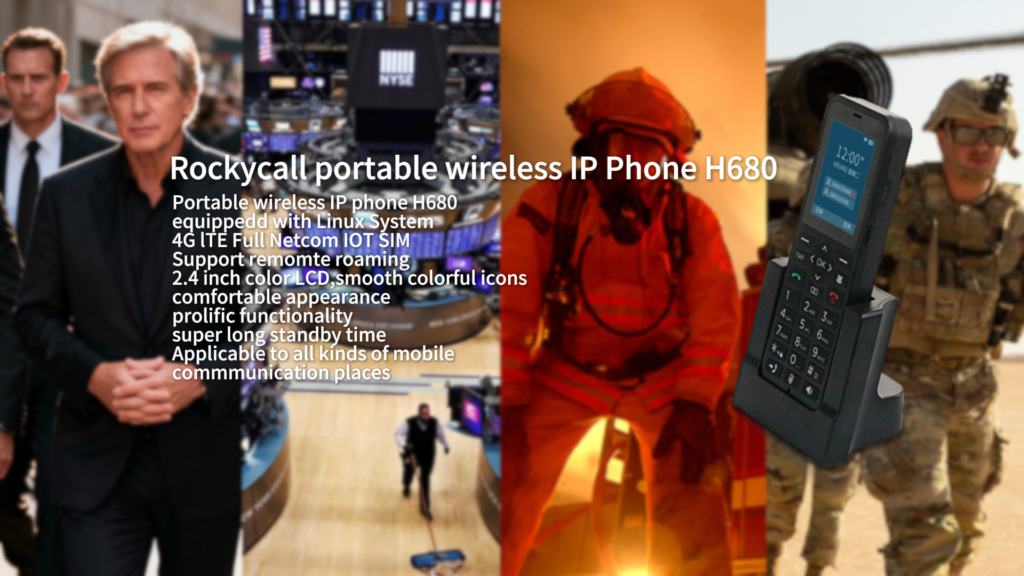
As a professional service provider focusing on enterprise-level cloud communication, Rockycall’s flagship model, the SIP-H680 IP Phone, is specially designed for enterprise mobile office, remote roaming, and multi-scenario communication needs. Relying on stable hardware configuration and flexible networking mode, it is suitable for enterprises of all sizes. The core highlights of the solution are as follows:
5.1 Core Terminal Solution (Rockycall SIP-H680)
|
Terminal Model |
Core Positioning |
Core Technical Parameters |
Adaptation Scenarios |
|
Rockycall SIP-H680 |
All-in-one Enterprise-grade IP Cordless Phone |
Equipped with Linux system, supporting dual networking modes: optional 4G LTE full Netcom IoT SIM card, or WiFi (single frequency 2.4GHz or dual frequency 2.4GHz&5GHz), built-in 802.11 a/b/g/n module, supporting remote location roaming; standard 2 SIP accounts, 2.4-inch color LCD display; with high-definition sound quality configuration, including high-definition earpiece, high-definition speaker, supporting 3.5mm high-definition headset access; equipped with microphone echo cancellation and noise reduction technology to achieve high-definition audio transmission |
Small and medium-sized enterprises, distributed offices, remote branch offices, mobile offices, retail stores, small service-oriented enterprises |
5.2 Core Advantages of the Solution
• Flexible Networking Mode: Supports dual-mode switching between 4G LTE full Netcom and dual-band WiFi, getting rid of the constraints of wired networks. Remote office locations and temporary workstations without fixed network coverage can also access stably. The remote roaming function is suitable for cross-regional office and field work scenarios;
• Professional Hardware Configuration: The native Linux system runs stably, not easy to freeze or crash. 2 independent SIP accounts can realize the separation of public and private lines and multi-line parallelism, meeting the needs of enterprise multi-line calls;
• High-quality Audio Experience: Equipped with professional high-definition audio hardware, combined with echo cancellation and active noise reduction technology, it effectively filters office environment noise. The call clarity is comparable to that of wired desk phones, adapting to noisy office areas, field work sites and other scenarios;
• Compatibility and Scalability: The standard SIP protocol is compatible with mainstream IP PBX systems and VoIP cloud platforms, which can seamlessly connect with enterprise CRM and collaborative office software, and support base station cascading expansion to meet the terminal expansion needs after enterprise scale expansion;
• Easy Operation and Deployment: The 2.4-inch color LCD display supports visual operation, no complex configuration is required, and it can be quickly registered and put online by inserting a card or connecting to WiFi, reducing enterprise deployment and operation and maintenance costs.
5.3 Deployment Cycle and Cost Reference
The deployment process of the Rockycall SIP-H680 terminal is extremely simple, without professional construction and wiring. Small enterprises (fewer than 10 people) can complete all terminal debugging and online in 1-3 days; medium-sized enterprises (10-50 people) have a deployment cycle of 3-7 days, supporting batch centralized configuration. In terms of cost, the unit price of the terminal is suitable for the budget of small and medium-sized enterprises, with no additional installation and debugging fees. The supporting VoIP communication package is charged according to actual usage. The tariffs for long-distance and international calls are much lower than those of traditional PSTN lines, and the overall communication cost can be reduced by 40%-60%, which is far more cost-effective than similar enterprise-grade IP phones.

VI. Summary and Suggestions
As an important terminal for modern enterprise communication, the core value of VoIP cordless phones lies in “wireless flexibility + professional efficiency + cost controllability”. They are especially suitable for small and medium-sized enterprises, distributed offices, mobile offices and other scenarios, and are a cost-effective choice for enterprise communication upgrades. When deploying, enterprises need to focus on three core links: network environment adaptation, terminal selection, and service provider selection. They should avoid blindly pursuing high-end equipment, but choose a “strongly adaptable, stable, and cost-controllable” solution in combination with their own business scenarios and communication needs.
For enterprises that need flexible networking, remote roaming, stable sound quality and simple deployment, the Rockycall SIP-H680 VoIP cordless phone solution is the preferred choice. Its dual-mode networking design, professional audio configuration and standardized SIP compatibility can cover the daily communication needs of most enterprises, while taking into account special scenarios such as field work, temporary office, and cross-regional collaboration, helping enterprises reduce communication costs, improve work efficiency, and enhance customer experience.
In the future, with the iteration of 5G and AI technologies, VoIP cordless phones will further integrate intelligent voice, AI customer service and other functions, becoming the core carrier of enterprise digital communication. Enterprises need to layout in advance and choose a scalable solution to reserve space for subsequent communication upgrades.